







The honest truth about SPF makeup: it works, and it doesn’t replace your dedicated sunscreen. Both statements are true simultaneously, and understanding why matters before you choose which SPF makeup products are worth adding to your routine. SPF in makeup provides meaningful additional protection — layered over a dedicated SPF, it extends and reinforces coverage as the day progresses and as the dedicated SPF begins to break down. Used alone, makeup SPF provides some protection but not the reliable, tested coverage of a dedicated formula applied at the recommended amount. The six products below are the makeup SPF options worth knowing because they’re genuinely good at being makeup first — the SPF is a legitimate bonus on top of excellent formulas, not a selling point pasted onto a mediocre product.
What You’ll Find In This Post:
- Why SPF in Makeup Matters — and What It Can’t Do
- 6 SPF Makeup Products To Try Now
- 1. The Foundation That Does It All
- 2. The Tinted Moisturizer for Lighter Coverage Days
- 3. The Primer That Protects Before Coverage Begins
- 4. The Powder That Reapplies SPF Without Disrupting Makeup
- 5. The Setting Spray That Extends Both Makeup and SPF
- 6. The Setting Spray That Refreshes and Protects
- Mini FAQ
- More SPF & Tanning Inspo
Why SPF in Makeup Matters — and What It Can’t Do
What SPF makeup does well: It adds a meaningful layer of protection throughout the day, particularly as your dedicated morning SPF breaks down from sweat, skin oils, and environmental exposure. A foundation or setting spray with SPF 30+ reapplied at midday is significantly more practical than reapplying a dedicated sunscreen over a full makeup look — which most people simply don’t do. SPF makeup makes consistent, all-day protection achievable in real life.
What SPF makeup can’t do: Fully replace a dedicated sunscreen applied at the recommended amount (about a teaspoon for the face and neck). Most people apply foundation at a fraction of the amount required to achieve the stated SPF on the label — which means the real-world protection from makeup SPF alone is lower than the number suggests. The correct system: dedicated SPF in the morning, makeup SPF as reinforcement throughout the day.
Why the formula quality matters: SPF in a foundation or primer that sits poorly on mature skin, emphasizes texture, or doesn’t wear through the day is not a net positive. Every product in this edit was chosen because it’s excellent makeup first — the SPF is a feature of a formula worth using regardless.
6 SPF Makeup Products To Try Now
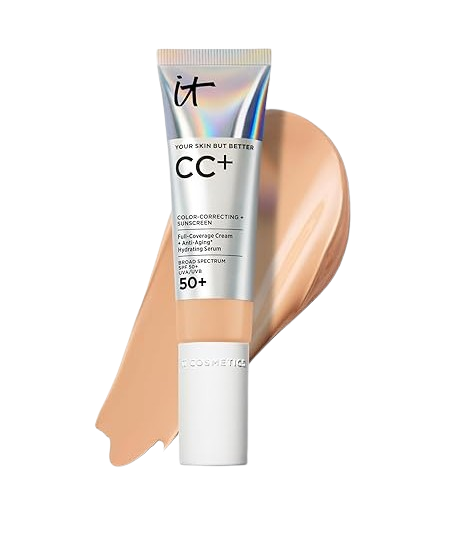
1. The Foundation That Does It All
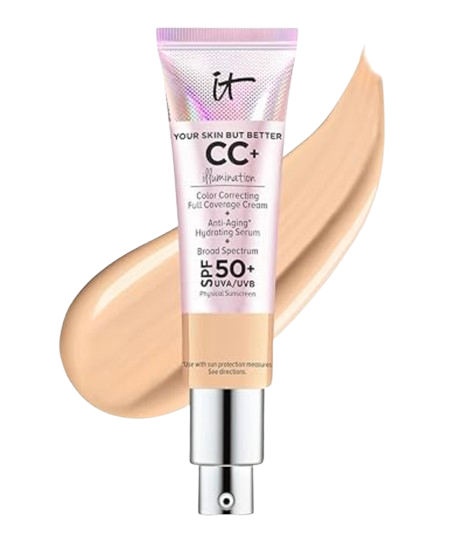
IT Cosmetics Your Skin But Better CC+ Cream — SPF 50+
The IT Cosmetics CC+ Cream is the product that converted the most dedicated foundation loyalists in a single application — it provides full coverage with a formula that actively improves skin texture over time through a blend of hydrolyzed collagen, peptides, niacinamide, and hyaluronic acid, all under SPF 50+ physical sunscreen. For mature skin specifically, the coverage formula was specifically developed to address the concerns that become most relevant after 50: redness, uneven tone, visible texture, and the need for coverage that doesn’t settle into fine lines. The finish is naturally luminous — not dewy, not matte, but skin-like in the way that the best foundations aspire to. Apply with a brush, a sponge, or fingers; all three methods produce a different but equally valid result.
The SPF note: At SPF 50+ with physical (zinc oxide and titanium dioxide) sunscreen, this is the highest-SPF option in the makeup category and works beautifully layered over the EltaMD UV Clear covered in the Allergy Season Skincare post. The combination gives you serious, layered protection with a finished, polished look.
2. The Tinted Moisturizer for Lighter Coverage Days
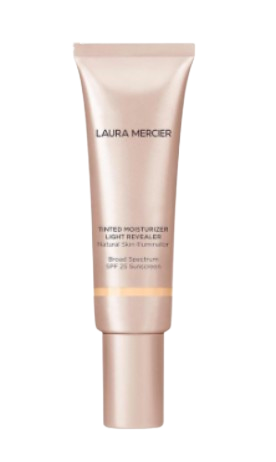
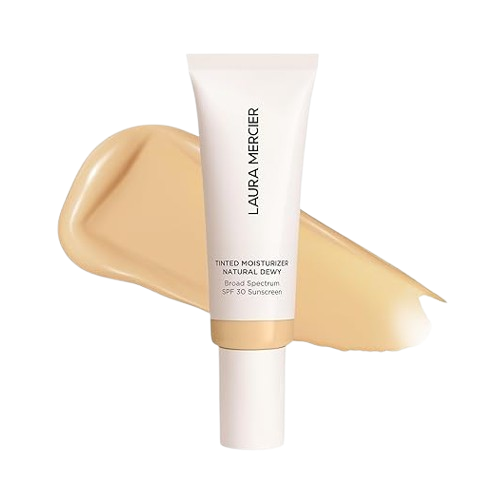
Laura Mercier Tinted Moisturizer — SPF 30
The tinted moisturizer is the format for the days when full foundation feels like more than the occasion requires — the weekend errand run, the outdoor lunch, the spring morning when the goal is healthy skin with a slight evening of tone rather than full coverage. Laura Mercier’s Tinted Moisturizer has been the standard-bearer in this category for years because it does exactly what it promises and nothing it doesn’t: light, buildable coverage that allows the skin’s natural texture to show, SPF 30 in a broad-spectrum formula, and a finish that reads as skin rather than product. Available in 30+ shades. Works on its own for light coverage or layered under powder for more. The formula that makes the “no makeup makeup” look achievable for the longest-lasting, most flattering version of it.
The SPF note: SPF 30 is the minimum recommended for daily facial sun protection. The Laura Mercier formula uses chemical filters, which sit lighter on the skin than mineral SPF but benefit from a 15-minute absorption window before sun exposure. Apply immediately after moisturizer, before the rest of your makeup.
3. The Primer That Protects Before Coverage Begins
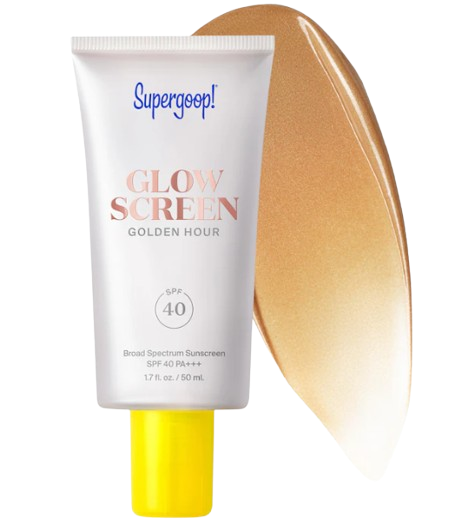
The Supergoop Glowscreen is technically a sunscreen that functions as a primer — and it does both jobs beautifully. The SPF 40 broad-spectrum formula goes on before foundation and creates a dewy, light-reflecting base that makes everything applied over it look more luminous and more polished. The hyaluronic acid and vitamin B5 in the formula add hydration at the primer stage, which means the foundation that follows sits more smoothly on a hydrated rather than slightly dry surface. For mature skin where dehydration is a persistent challenge, the priming SPF that hydrates while protecting is the most efficient step in the morning routine. It also functions beautifully alone on no-makeup days as the tinted SPF covered in the self-tanner guide — applied over self-tanned skin, it’s a complete morning skincare and protection step in one.
The SPF note: The Glowscreen’s glow finish is the element worth considering for your specific skin — if you run oily, the luminosity may be more than you want as a daily base. For normal to dry skin, and for mature skin specifically where luminosity reads as healthy and alive rather than shiny, this is the primer worth reaching for.
4. The Powder That Reapplies SPF Without Disrupting Makeup
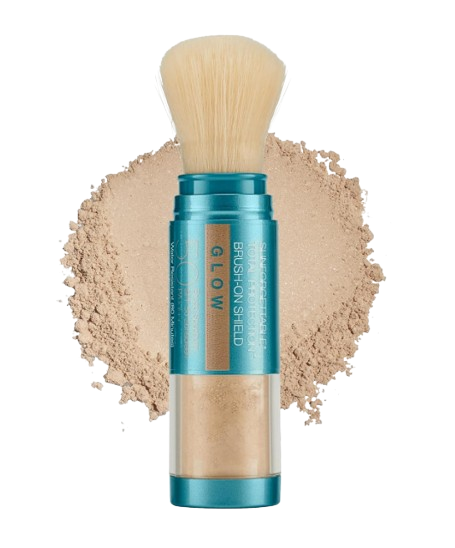
Colorescience Sunforgettable Total Protection Brush-On Shield — SPF 50
This is the product that solves the midday SPF problem without requiring you to remove and reapply your entire makeup look. The Colorescience brush-on powder delivers SPF 50 in a mineral formula (zinc oxide and titanium dioxide) that can be applied directly over a full makeup look — foundation, concealer, powder — without disrupting the layers underneath. Sweep the built-in brush across the face, neck, and décolletage and the SPF is refreshed in thirty seconds. For women over 50 who wear makeup daily through outdoor spring and summer activities, this is the practical tool that makes all-day protection achievable without the theoretical “I’ll reapply over my makeup” plan that almost never happens in practice.
The SPF note: This is the midday SPF reapplication solution referenced in both the SPF Products post and the Self-Tanner Guide — the product that makes layered, maintained sun protection achievable in real life rather than only in theory. Worth keeping in the bag alongside the Summer Fridays travel fragrance from last week.
5. The Setting Spray That Extends Both Makeup and SPF
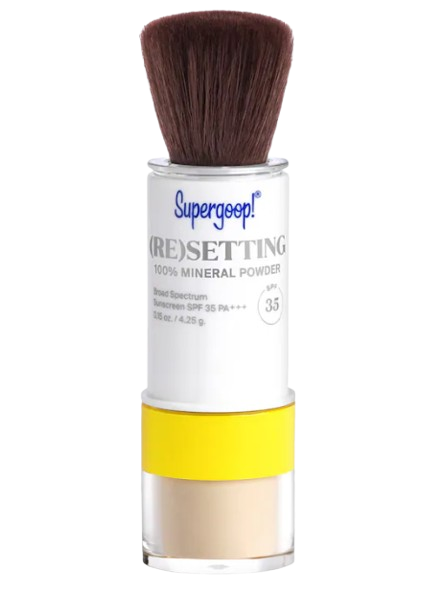
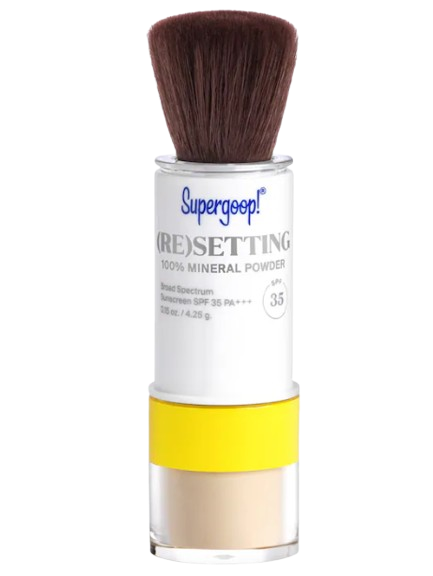
Supergoop! (Re)setting 100% Mineral Powder SPF 35
A second Supergoop entry because the brand has solved two different problems in two different formats. Where the Glowscreen is a primer, the (Re)setting Powder is a finishing and touch-up tool in SPF 35 mineral formula — it sets makeup, controls shine, and reapplies SPF simultaneously in one step. The pressed powder format is travel-friendly, the SPF is 100% mineral (appropriate for sensitive and reactive skin), and the finish is natural rather than cakey, which is the specific failure mode of powder SPF products that don’t account for layering over other products. For the Grit and Glam reader who wants her SPF routine to be as efficient as her makeup routine, this is the product that combines both without compromise.
The SPF note: Mineral SPF in a powder format is the form of SPF reapplication most compatible with a full makeup look — it doesn’t disrupt the base underneath, doesn’t add liquid over powder, and dries to a finish rather than requiring blending. The SPF 35 is meaningful protection at the midday reapplication stage.
6. The Setting Spray That Refreshes and Protects
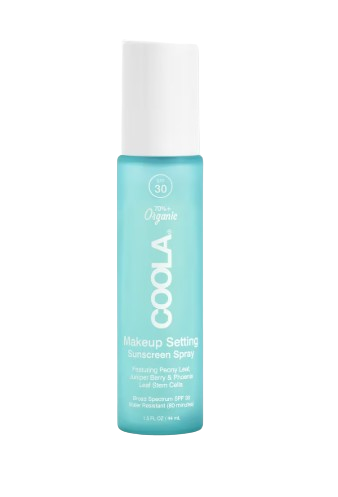
Coola Makeup Setting Spray Organic Sunscreen — SPF 30
The setting spray format is the most invisible form of SPF reapplication — a mist held at arm’s length, eyes closed, that sets makeup, refreshes the skin, and adds an SPF layer in the time it takes to spritz a perfume. The Coola Makeup Setting Spray uses a certified organic formula with SPF 30 that doesn’t leave a white cast, doesn’t disrupt underlying makeup, and has a light, clean scent that dissipates quickly. For women who want SPF reapplication to require zero additional steps or tools — no brush, no sponge, no additional product — this is the spray that makes midday protection effortless. It’s also the format most compatible with self-tanned skin, where a mineral powder might subtly disrupt the surface tone.
The SPF note: The mist format distributes SPF evenly across the face and neck in a way that’s difficult to achieve with a powder or a brush-on formula — the coverage is genuinely comprehensive if the spray is applied correctly (at arm’s length, in a slow, circular motion, eyes and mouth closed). Two or three spritzes over the full face and neck is the correct application.
The SPF Makeup Routine: Morning Through Evening
Morning: Dedicated SPF (the EltaMD UV Clear or similar mineral formula covered in The SPF Products I’m Actually Excited to Wear) applied to clean skin after skincare. Allow 15 minutes to absorb. Then the Supergoop Glowscreen as primer. Then foundation (IT Cosmetics CC+ or Laura Mercier Tinted Moisturizer depending on the coverage day). Set with the Supergoop (Re)setting Powder or the Coola mist.
Midday (after 2 hours of sun exposure or at lunchtime): The Colorescience brush-on SPF 50 powder for a quick SPF refresh over the full makeup look — sweep across face, neck, and chest, done in thirty seconds. Or the Coola setting spray mist for the invisible reapplication option.
The realistic version: Even if you only do the morning dedicated SPF and add the IT Cosmetics CC+ Cream, you’re ahead of the majority of women your age in terms of sun protection. The midday reapplication is the ideal; the morning layered approach is the minimum that meaningfully protects.
What to Look For in SPF Makeup
SPF 30 minimum, SPF 50 ideal. SPF 30 blocks approximately 97% of UVB rays; SPF 50 blocks approximately 98%. The difference seems small mathematically but is meaningful over cumulative daily exposure. For makeup you’re applying anyway, there’s no reason to choose SPF 15 over SPF 30 or SPF 30 over SPF 50 when the higher protection is available in a formula you like.
Mineral vs. chemical filters in makeup. Mineral SPF (zinc oxide, titanium dioxide) sits on the skin and reflects UV rays — generally more appropriate for sensitive and reactive skin, and the option for those who prefer to avoid chemical filter ingredients. Chemical SPF absorbs UV rays and converts them to heat — typically lighter on the skin, no white cast risk, but requires the 15-minute absorption window before sun exposure. Both are effective; the choice is personal.
Broad-spectrum is non-negotiable. Broad-spectrum means protection against both UVA (aging) and UVB (burning) rays. A product without the broad-spectrum designation only protects against UVB. For anti-aging and cancer prevention purposes, UVA protection is equally important. All six products in this edit are broad-spectrum.
Finish compatibility with your skin type. A dewy-finish SPF primer on oily skin creates a situation by midday. A matte-finish SPF on very dry skin emphasizes texture. Match the finish of the SPF makeup product to what your skin needs — the descriptions above flag each product’s finish specifically for this reason.
Mini FAQ
Not reliably — the amount of foundation or primer most people apply is a fraction of the amount required to achieve the stated SPF on the label. The dedicated SPF as the first step, makeup SPF as reinforcement, is the system that provides consistent protection. If you genuinely won’t apply a dedicated SPF, the highest-SPF foundation you can find (the IT Cosmetics CC+ Cream at SPF 50+ is the best option) is significantly better than nothing.
Every two hours of direct sun exposure is the general guideline, consistent with dedicated SPF reapplication. The Colorescience brush-on or the Coola setting spray are the practical tools for this — both are portable and both reapply without disrupting the makeup underneath.
The SPF in makeup formulas can degrade from sweat, skin oils, and environmental factors the same way dedicated SPF does — which is why midday reapplication matters regardless of the SPF level in the morning’s foundation. SPF makeup doesn’t provide extended protection relative to dedicated SPF; it provides layered and renewed protection when reapplied.
Yes — the formula was specifically developed with mature skin in mind and the hydrolyzed collagen and peptide blend makes it genuinely conditioning over time. Apply with a damp beauty sponge for the most skin-like finish on mature skin, which tends to show foundation texture more readily than a brush application.
Yes — mist at arm’s length with eyes and mouth closed, in a circular sweeping motion. The spray distributes evenly enough that it sets rather than moves powder foundation when applied correctly. The key is the distance (arm’s length, not close-range) and the light, even motion.
✨ Beth’s Take: The SPF Routine That Finally Became Automatic
For years my SPF routine was dedicated sunscreen in the morning and then optimism for the rest of the day — which is not a sun protection strategy but is what most women over 50 are actually doing. The midday reapplication was theoretically important and practically nonexistent because nobody is removing their makeup and reapplying sunscreen in the middle of a workday.
The Colorescience brush-on powder changed this for me more than any other single product in the SPF category. It takes thirty seconds. It goes directly over makeup. It works. That’s the complete description of why it became a daily habit where nothing else had — the barrier to reapplication was low enough that I actually did it rather than meaning to. It lives in my bag permanently now, alongside the Supergoop Glowscreen that goes on under everything in the morning.
The IT Cosmetics CC+ Cream was the other revelation — not because of the SPF (though the SPF 50+ is genuinely the highest available in a foundation format) but because it’s the best foundation I’ve found for mature skin. The coverage, the finish, the way it doesn’t settle into fine lines by midday. The SPF is a feature of an excellent product rather than a reason to tolerate a mediocre one, which is exactly the standard worth holding every SPF makeup product to.
More SPF & Tanning Inspo
For the dedicated SPF formulas that go under everything in this guide, The SPF Products I’m Actually Excited to Wear covers the morning sunscreen step that makes the makeup SPF reinforcement meaningful. And for the self-tanner and SPF strategy that keeps spring skin glowing and protected simultaneously, The Self-Tanner Guide for Women Over 50 is the companion post that closes the spring skin picture.
Closing Thoughts
Ready to Upgrade Your SPF Makeup Routine?
Dedicated SPF first, always. Then the Glowscreen or the tinted moisturizer or the CC+ Cream, depending on the coverage day. The Colorescience brush-on in the bag for midday. The Coola mist for the days when thirty seconds of invisible SPF refresh is all you need. The system is straightforward, the products are excellent, and the sun protection that results is meaningfully better than the morning-only approach that most of us have been running on. Start this week.