






A Ralph Lauren Twill Lady Jacket. A Charlotte writers’ conference. And the moment everything changed.
Before we talk about the jacket, meet Reggie.
She’s the woman at the center of my debut novel, Hidden in the Frame. She’s a Hollywood actress navigating an art forgery scandal tied to her father’s past. She’s complicated, guarded, and braver than she knows. And she has very strong opinions about Mondays.
A few weeks ago, I sat across from a literary agent at a writers’ conference in Charlotte, North Carolina, and pitched her story for the first time in person. Ten minutes. Face to face. Everything I’d worked toward for years.
The agent requested the full manuscript.
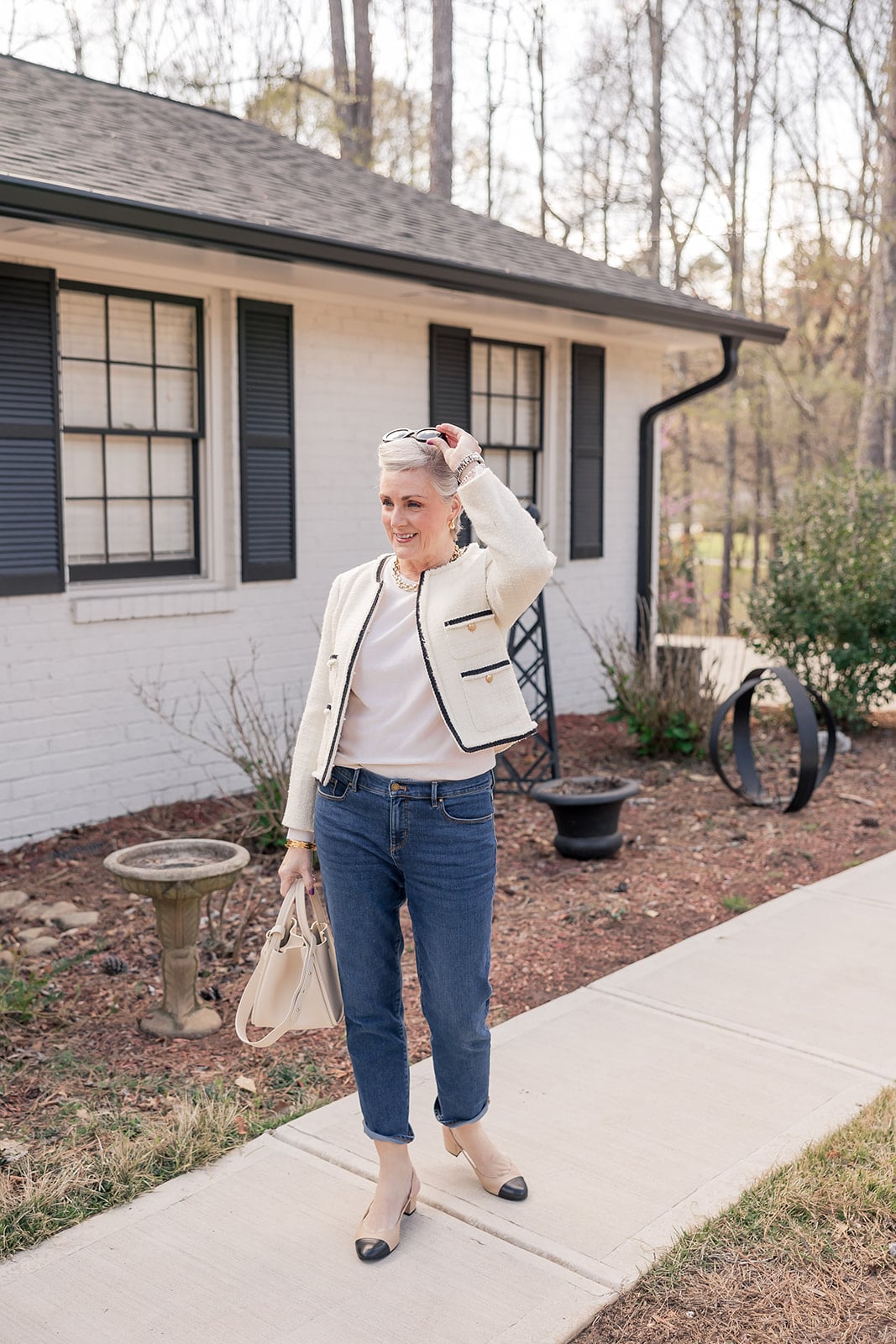
I was wearing the Ralph Lauren Twill Lady Jacket. I will never question it.
But before we get to the jacket — I want you to meet Reggie. Chapter One, as it stands today, submitted for agent review. Grab your coffee.
Table of contents
- Style Has to Feel Like You — Or It Doesn’t Work
- Ralph Lauren Twill Lady Jacket Outfit Over 50: The Full Look
- How I Styled It: The Full Look
- Charlotte Was Buzzing — And Beautifully Dressed
- The Confidence Factor: What You Wear to a Big Moment Matters
- FAQ: Styling a Lady Jacket Over 50
- Shop the Look
- Want to Follow Reggie’s Journey?
- More Spring Inspiration
HIDDEN IN THE FRAME
Chapter One
Monday, August 13, 10:15 a.m. — Chicago, Illinois
Reggie Cavanaugh didn’t trust Mondays. Other people had superstitions about black cats and spilled salt. Reggie had Mondays. They showed up promising a clean slate, then sucker-punched you before lunch. Fridays had an acronym and cocktails. Mondays just found a way to go off script.
But today, surrounded by twenty faces full of anticipation—some propped on pillows, some tangled in blankets, some holding hands with a friend beside them—maybe this was the Monday that would prove her wrong.
Through the pediatric wing’s observation window, she caught Claire’s signal: two fingers tapped her watch, then pointed toward the exit. Wrap it up. The sharp scent of antiseptic hung in the air, barely masked by cheerful animal decals peeling at the corners.
“One more?” a small voice asked.
The little girl held a stuffed rabbit tight to her chest, hospital bracelet slipping down her wrist, eyes fixed on Reggie as if nothing else in the world existed.
Dear Lord. That look.
Reggie’s throat tightened. But she smiled and nodded. As if another book could make something hurt less. Still. It was something.
Through the window, Claire pointed at her watch and mouthed no.
Screw the schedule. Reggie grinned, lifting a finger in mock victory.
Claire threw her hands up, mouthing Cavanaugh, but she was smiling.
“One more,” she said to the children. She opened the book, her thumb tracing the spine, and began.
“In the great green room, there was a telephone…” Her voice carried steady and warm, filling the quiet. By the final page, the room had softened, as if every child had followed her into that green room and refused to leave. She slowed, then looked up at the children.
“Let’s say this part together,” she said. “Ready?”
Twenty voices, thin and strong, rose to meet hers.
“Goodnight stars. Goodnight air. Goodnight noises everywhere.”
The girl with the rabbit mouthed every word, her hands folded as if in prayer.
Reggie closed the book softly, the stillness in the room achingly familiar—that cathedral quiet after the last page, before sleep, when everything felt manageable. For a moment, Reggie was a girl again, tucked under her quilt, her father closing the book, his voice low and certain: “Time to turn out the light, Fish.”
Before it all fell apart. Back when fathers seemed invincible. Back when Saturday mornings meant the gallery on West Superior Street in River North—the old converted warehouse that smelled of linseed oil and turpentine, where Charles held court with collectors and restorers while Jane corrected his provenance from across the room and Reggie sat cross-legged on the stockroom floor, sketching whatever caught her eye. The three of them in that bright, cluttered space, arguing about light the way other families argued about dinner.
She’d believed every word he said. She’d believed the paintings in the back room were treasures. They were. Just not the way she’d thought.
***
Reggie shifted on the worn vinyl couch, Goodnight Moon resting in her hands—Wednesday night, it would go to auction. Her father’s book. The only thing she’d kept from before.
It had been a gift to Charles from Clement Hurd himself, signed with a note of thanks for “believing in bedtime stories.” It would fetch a fortune—not that she needed it. But the foundation wasn’t built on Cavanaugh family money. It was built on Reggie’s. Her work. Her name. Not his.
She pressed her thumb against the spine, where his fingerprints had worn the cover smooth. Wednesday night, someone else would touch this binding. Someone who’d never heard him read about the great green room in that voice that made the whole world safe.
Before he made it dangerous.
She’d built a life precise enough to make him irrelevant. Roles chosen, interviews vetted, not a single Cavanaugh question she hadn’t rehearsed answers for. Wednesday night, she was going to prove it — to the donors, to the press, to herself. One auction. One clean goodbye. Then Paris.
A familiar pinch gathered behind her eyes. Not today. Not ever again. She steadied herself with a slow breath through her nose, then reached into her bag for the small stack of needlepoint bookmarks she’d stitched during late nights on set, when three a.m. insomnia struck and scripts wouldn’t stop running through her head. Sunflowers and stars. A sailboat. A ballerina. She’d made one for each child.
“Before you go,” she said, holding them up. “I made these for you. One for everyone.”
The children’s eyes went wide.
The girl with the rabbit reached out first, fingers trembling as she chose the fox. “You made this?”
“I did.”
“For me?”
“For you.”
The girl clutched it the way she clutched her rabbit — like letting go wasn’t an option. One by one, the children came forward. A boy chose the rocket ship. Another picked the bear. A girl claimed the sunflowers. Each one careful, reverent, as if the bookmark might disappear.
This. This was why she’d started the foundation. Not the press. Not the galas. This moment, when a sick child held something made just for them and forgot, for one second, that the world could be cruel. Her father used to say stories were the only safe place. She’d spent fifteen years proving him wrong about everything else. But this part—this quiet communion between a story and a child—maybe he’d been right about this.
***
Six more weeks of filming. Six more weeks of call sheets and camera angles, then she was done. Done letting studios and strangers turn her family wreckage into glossy myth.
The apartment in Paris was already hers—quiet, sunlit, waiting. She’d fallen in love with the city junior year at the Sorbonne, the semester she’d stopped being Charles Cavanaugh’s daughter and become simply Reggie. Paris had given her that—the first place that didn’t ask where she came from. After the Oscar, she’d bought the apartment as a promise to herself that one day she’d stop running and simply live.
Six more weeks, and she could finally breathe.
A little boy in the front row shot his hand into the air. “Miss Cavanaugh?”
“Yes?”
“Do you really run from bad guys like in the movies?”
Reggie laughed. “In this movie, they make me run in heels.” She lowered her voice conspiratorially. “Terrible idea. Don’t try it.”
The boy grinned, gap-toothed. The room rippled with giggles until the door swung open and Patricia, the pediatric nurse, rolled in a cart stacked with cups of vanilla and chocolate ice cream.
“Who wants dessert before lunch?” she asked.
The room erupted into squeals of delight.
Patricia pressed two cups into Reggie’s hand. “Hospital rules. Everyone gets ice cream after story time.”
Reggie studied the options, her brows lifting. “Chocolate or vanilla, Patricia? That’s cruel.”
Patricia blinked, smiling a touch too quickly. “Chocolate,” she confessed, as if it were classified.
The kids erupted with their own shouts of “chocolate!” and “vanilla!” while Reggie grinned, letting the moment play like a scene meant just for them.
“Chocolate it is!” Reggie said, savoring a spoonful—cold, sweet, simple. Perfect in a way no Michelin star could match. Just chocolate ice cream in a paper cup, eaten with a wooden spoon surrounded by smiling faces.
Miles Kelley leaned in the doorway, arms crossed. He had a way of watching that made you forget he was doing it.
“Want some?” She held up her ice cream cup. “Or does your protein regimen forbid sugar before noon?”
“I’ll make an exception.” He pushed off the doorframe but didn’t close the distance. Neither did she.
“Liar. You’re just here to spy.”
“Admiring. You’re good with them.”
Something in the way he said it—not performing, not flirting, just observing—caught her off guard. She recovered fast. She always did.
“Careful. That almost sounded sincere.”
“I am sincere. Just surprised you agreed to do this on a Monday morning when we’re already behind schedule.”
“Some things matter more than call times, Kelley.”
His mouth curved. “That’s not very ice-queen of you.” He went still. Just for a second—the way a man goes still when he’s said more than he meant to.
“You’re confusing me with the blonde from the vampire franchise.”
Something shifted behind his eyes—half apology, half dare. She filed it away the way she filed everything about Miles Kelley: carefully, against her better judgment. Two months of banter that felt like fencing, of silences that lasted a beat too long, of catching him watching her when he thought she wasn’t looking. She kept a running tally of reasons not to care. The tally never quite worked.
He rolled his shoulders. “Ready?”
“Are you offering to go first?”
“Moral support. And maybe a human shield.”
“How chivalrous.”
His phone buzzed. He glanced at it, and something crossed his face that didn’t belong to the conversation—quick, involuntary, gone before she could name it. Like a man seeing a headline he’d hoped wouldn’t break yet.
“I should go.”
“Press getting restless?”
“Something like that.” He was already moving toward the exit, phone pocketed rather than answered, which was the part that stayed with her.
She watched him disappear around the corner. Abrupt, even for Miles.
The problem with Miles Kelley wasn’t the charm or the tabloid history. The problem was everything else—the way he remembered the name of every crew member’s kid, the dead poets he quoted when he thought nobody important was listening, the way he’d shown up at a children’s hospital on a Monday morning because he wanted to. The surface was easy to resist. She’d been resisting surfaces her whole life. What was underneath it kept her up at night.
And that terrified her. Because the last man she’d loved without reservation had taught her the most durable lesson of her life: the people you love the most are the ones who can destroy you.
She wasn’t about to learn it twice.
Patricia reappeared with her phone. “Ms. Cavanaugh? One quick photo for the children’s wall?”
“Of course,” Reggie smiled as Patricia snapped three shots. She kept Goodnight Moon in her hand—holding the book felt right. Proof of why she was there.
***
Claire appeared at her elbow, steering her toward the door. “Time to get this show on the road, Reg.” She didn’t just manage time; she ruled it. Claire was seven inches shorter and still managed to manhandle her like a linebacker—quick wit, quicker elbows, the same girl who’d dragged her up a rock face during Wildcat Wilderness freshman year and never really let go.
“We’ll stop at the base of the stairs,” she said. “Two, maybe three softball questions. Then your statement. Then we disappear. And for the love of God—no winging it.”
Reggie almost laughed. Improvising was for people who trusted instinct. Reggie trusted choreography.
Through the glass doors, they watched the gathering storm. Children’s Memorial had turned into a media circus: four TV trucks, a dozen tabloid reporters, local press, hundreds of fans, and paparazzi in full plumage. Vultures, really. Circling.
“Deep breath,” Claire murmured. “Let’s toss those buzzards some scraps.”
The sliding doors hissed open. Flashbulbs popped like machine-gun fire, the kind reserved for scandal or sainthood. One hand shielded her eyes while the other rummaged through her quilted handbag. The smile came easily. Her eyes were the problem—photographers loved to zoom in, searching for tears or rage, anything that sold magazines.
She rarely appeared without her Céline sunglasses—her armor against the world. Her fingers closed on them now. The second they slid into place, she could breathe again, anonymous behind glass, untouchable. Face composed, her slick blond ponytail catching the sunlight, she gave the crowd a practiced wave.
When a long lens lunged too close, Claire clamped onto her elbow and steered her down the steps.
***
Reggie eyed a perky blonde from WGN checking her reflection in the camera monitor. Tongue swipe, hair flip, teeth like a Colgate ad. As she breezed past, the mic shot up. “Reggie!” the blonde shrieked. “Tell us, what’s it like working with Miles Kelley?”
Of course. That would be the first question. What else would they lead with?
Miles held court at the bottom as if he’d been born for it. All ease. All charm. All Miles. Hair swept back, black fitted shirt, worn-in jeans, Frye boots scuffed just enough to look real, not styled. Hollywood knew how to costume a man. Miles never needed the help.
He played to the cameras, but she caught him scanning the crowd. Noting the exits. Old habit, or new worry?
At the sound of his name, Miles turned. That smile. That lifted brow. That way of looking at her like he had all the time in the world.
Her pulse kicked. Dammit.
She held his gaze—three seconds, four—then broke it deliberately, the way you set down something fragile before your hands start shaking. She’d spent two months not letting him see the way he got under her skin. She wasn’t about to start now, not in front of half of Chicago, and not when she knew how the story ended for women who let their guard down.
She forced her attention back to the reporter, the crowd, anywhere but Miles. Years of media training closed over her like a soundstage door. She stepped into the role the public paid for. She smiled like she meant it. She leaned into the mic, summoning her publicist’s favorite mantra: We use the media. They don’t use us.
“According to People magazine,” she said sweetly, “I’m working with the sexiest man alive. And I have to agree—he’s not exactly hard on the eyes.”
The crowd chuckled. Solid start.
She knew he thought the title was ridiculous. She also knew about the seventy acres in Minnesota, the way he disappeared between projects into a life no one in Hollywood could account for. A fellow Midwesterner. She noticed too much. That was the problem.
She glanced back. Still amused. Still watching. But now—measuring. He gave her a slight nod. She felt the pull. Ignored it. Turned back to the reporters.
“Reggie!” a Tribune reporter called out. “How does it feel to be back in Chicago?”
Reggie laughed, tossing her head back. “Still my kind of town,” she said, and meant it.
Right on cue, a breeze swept in off Lake Michigan, cool and insistent. After a week of ninety-degree misery, it felt like a benediction.
Even in the dog days of summer, Chicago still felt like home. She could fly down the streets in her Jaguar with muscle memory alone; the skyline never quit showing off, and the caramel popcorn was still the best this side of the Mississippi.
Her apartment in Paris had better wine and fewer memories. But it didn’t have Jane.
Not the official reason she’d signed on for the remake of North by Northwest—but it hadn’t hurt. Chicago meant six weeks near her mother, actual time together instead of polite phone calls that skirted everything that mattered. And the paycheck was big enough to fund the foundation and step away from Hollywood on her own terms. No Cavanaugh trust funds. No family safety net. Just her work, her name, her clean break.
***
Another voice rang out. Younger. Male. Accented.
“Ms. Cavanaugh, any comment on the forged Degas discovered at the Musée d’Orsay? The one signed by your father?”
The world tilted.
Flashbulbs strobed white. The crowd pressed closer, but the sound went distant, underwater, the way it had gone once before. Her hand shot out, finding Claire’s elbow, gripping hard enough to leave marks.
Signed by your father.
Her vision tunneled. She was seventeen again—Emily Webb costume, white dress, hair in braids, sixty minutes until curtain. Opening night of Our Town. The doorbell rang. And kept ringing.
Federal agents pouring through the house. Her mother in the foyer, pearls and silence. Her father’s face gone gray. Handcuffs. The front door. Photographers on the lawn.
Then an agent’s hand on her arm—not rough, but firm.
“We need to ask you some questions, Miss Cavanaugh.”
Separate cars. Separate interrogations. By morning, it was everywhere—Chicago to Paris. Charles Cavanaugh, art forger.
That was fifteen years ago. She’d built a career since then, polished enough to reflect back whatever the world wanted to see—immaculate, dazzling, untouchable. A surface so smooth that nothing from underneath could show through.
And now his signature—his—was tied to a forged Degas hanging in the Musée d’Orsay. If the story broke wrong, the gala, the foundation, the clean exit she’d spent fifteen years engineering could all go up in the same flashbulb burst.
Her mind was already running the calculus. The gala Wednesday night—donors, board members, Goodnight Moon on the auction block. The studio. And Miles—God, Miles had seen her face go white, seen her hand shoot out for Claire like a woman reaching for a lifeboat. Whatever she’d been hiding for two months, he’d just watched it surface in real time.
Beside her, Claire’s arm locked around her waist—steady, immediate, the grip of someone who knew exactly what an ambush felt like and exactly how to walk away from one.
The sunglasses hid her eyes. The smile held. Her hand on Claire’s arm was the only part of her telling the truth. Somewhere, editors were already rewriting her story.
Monday had finally shown its teeth.
I walked into that pitch room wearing this jacket. Ten minutes later, an agent asked to read the whole book.
Now you understand why I’m calling it my lucky jacket.
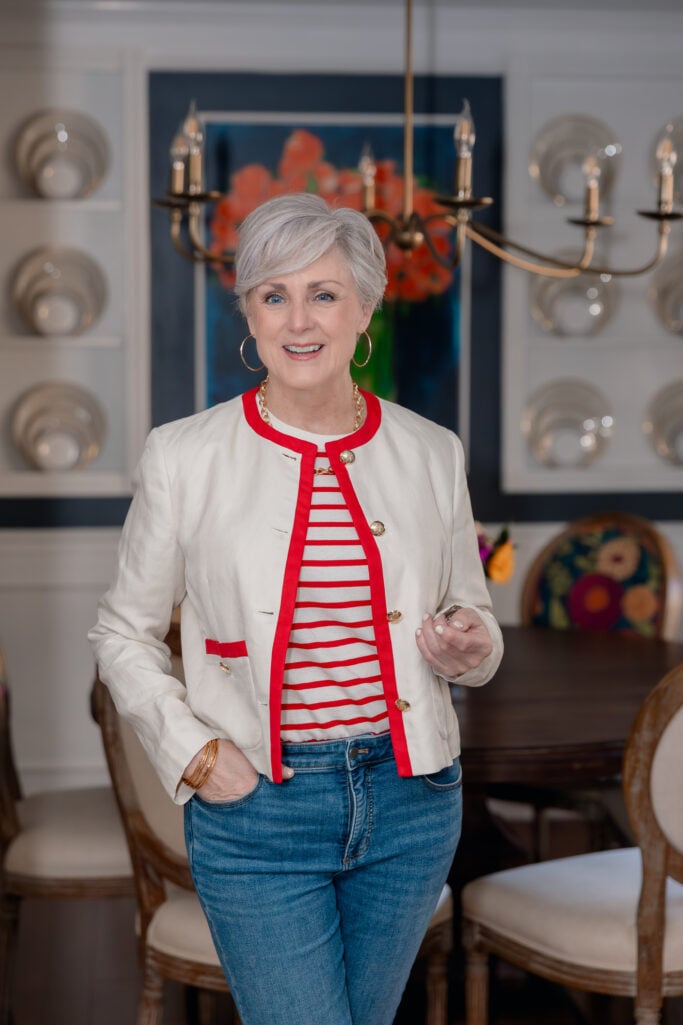
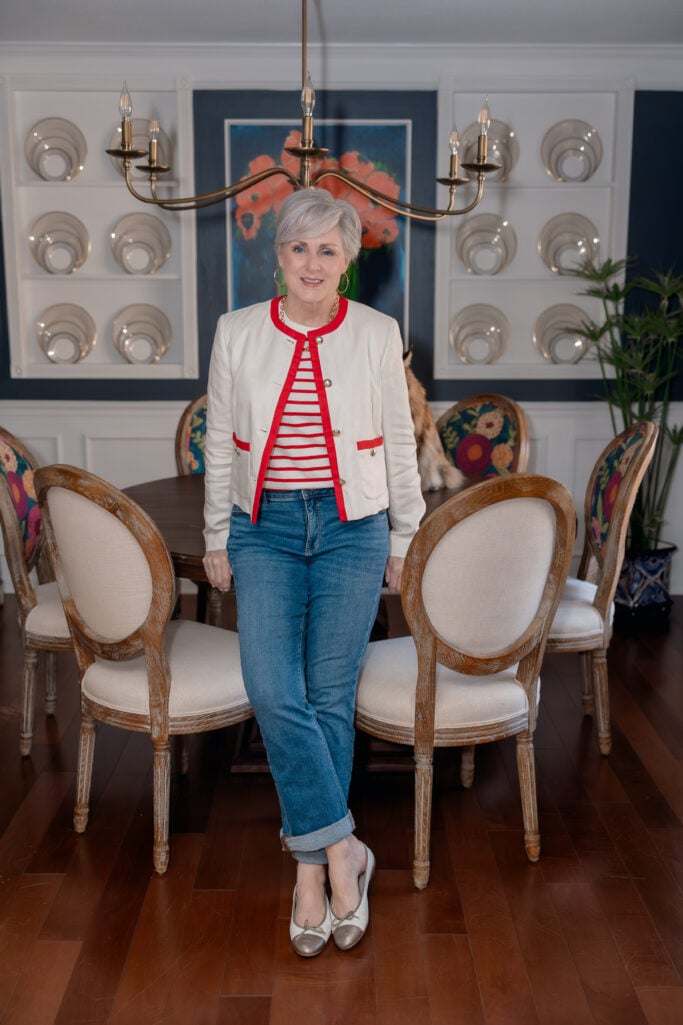
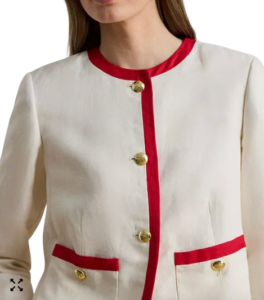
I was wearing the Ralph Lauren Twill Lady Jacket when I sat across from a literary agent at the Charlotte Writers’ Conference and pitched Hidden in the Frame for the very first time, face to face. When she looked up from her notes and said she wanted to read the full manuscript, I was in cream and red, with gold buttons and cap-toe ballet flats, seated in a conference room that suddenly felt like the most important room I’d ever been in.
Style Has to Feel Like You — Or It Doesn’t Work
I’ve never been someone who suffers for fashion, although that was my Mother’s mantra. Life is too short and the occasions too important.
What I’ve learned after years of getting dressed — for videos and photo shoots, for events, for ordinary Tuesdays — is that the outfit has to be me. Up to date, yes. Modern, absolutely. But completely, recognizably, undeniably me. The moment I’m pulling at a hemline or second-guessing a silhouette, I’ve already lost the room. Confidence doesn’t come from wearing something impressive. It comes from wearing something true.
The Ralph Lauren Twill Lady Jacket is true. It’s been true for years.
So when I put it on that morning in Charlotte, I wasn’t thinking about making a statement. I was thinking about walking into that pitch feeling like myself — which, it turns out, is the only thing worth feeling.
Reggie Cavanaugh gets this.
When we first meet her in Chapter One, she’s in a simple ivory linen sheath and ballet flats. No fuss. No Hollywood. Just a woman who chose comfort and quiet over performance because the moment — sick children, a story, a stuffed rabbit — called for exactly that. It’s the most herself she is in the entire chapter.
Then the hospital doors open. The flashbulbs start. And her hand goes straight to her Céline sunglasses.
Same woman. Different armor. Both completely intentional.
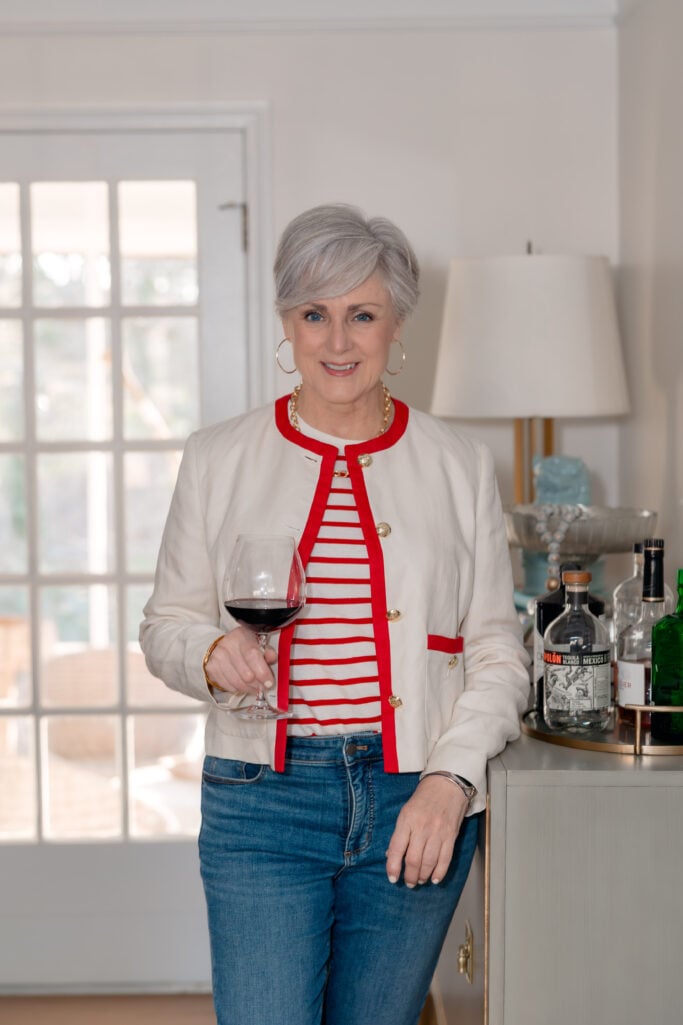
Ralph Lauren Twill Lady Jacket Outfit Over 50: The Full Look
Ralph Lauren is, hands down, my favorite designer. Has been for years. There’s something about the way his clothes understand a woman — constructed to look expensive without screaming for attention, classic without being stiff.
The Twill Lady Jacket is the embodiment of that philosophy. The cream body with bold red trim is quintessentially Ralph: preppy, refined, quietly confident. The gold buttons elevate it from casual to considered. It’s structured enough for a pitch meeting with a literary agent, relaxed enough with jeans and ballet flats to feel completely yourself.
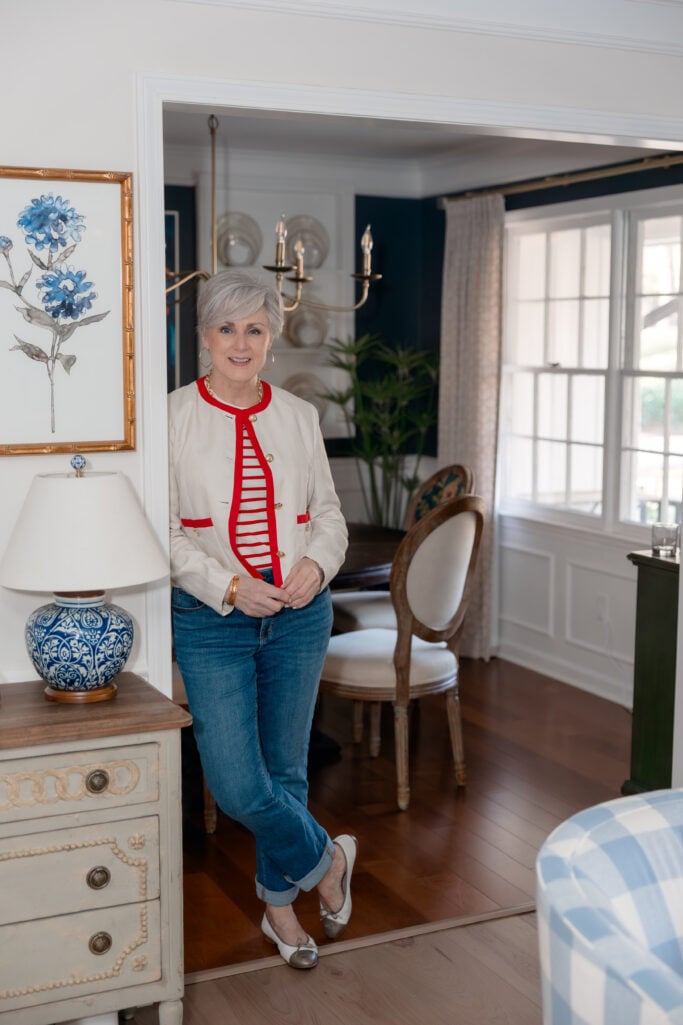
How I Styled It: The Full Look
The question with a statement jacket is always: what do you build around it? My answer — keep everything else clean and let the jacket lead.
- Jacket: Ralph Lauren Twill Lady Jacket in cream with red trim
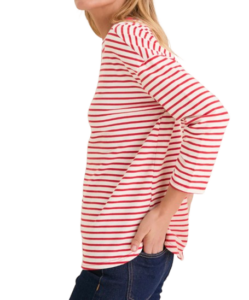
- Top: Red and white striped tee — the jacket’s trim does the coordinating work for you
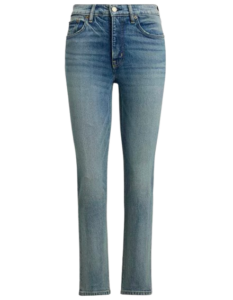
- Jeans: Medium-wash straight leg, cuffed at the ankle — classic, not trendy
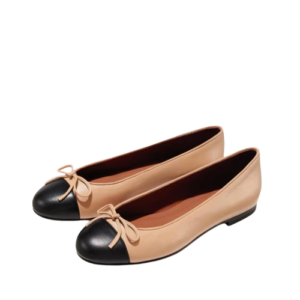
- Shoes: Cap-toe ballet flats (old, similar here) — unexpected and perfect
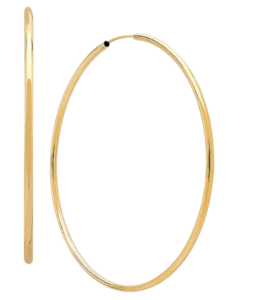
- Jewelry: Gold hoop earrings that echo the jacket’s buttons
The red stripe in the tee picks up the jacket’s trim so that what reads as “two separate pieces” on the hanger becomes one cohesive look when worn. That’s the magic of intentional color repetition — one of the easiest styling moves over 50.
The cap-toe ballet flats were the easy move. They add a touch of old school prep without disrupting the classic register of the rest of the look. Wear what makes you smile.
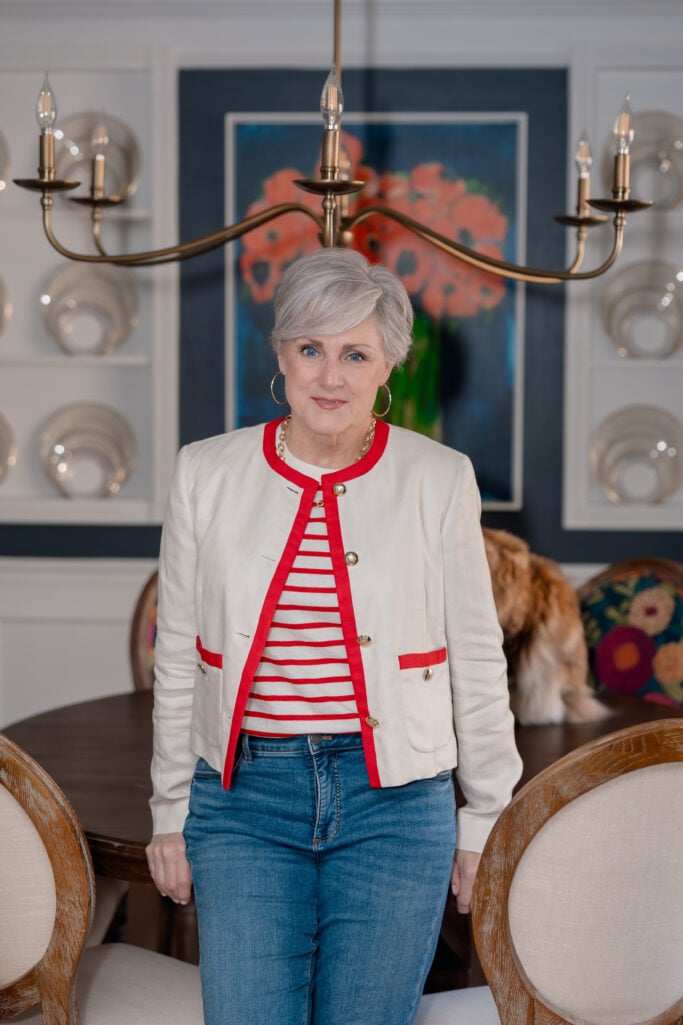
Charlotte Was Buzzing — And Beautifully Dressed
The conference was held in Charlotte, and I want to say a word about that city’s energy right now: it was alive.
The mall near the conference hotel was absolutely packed — from high-end boutiques to Nordstrom to J.Crew, every store was full of women shopping with intention, investing in beautiful clothes, treating themselves to something worth it. It was genuinely energizing to witness.
There’s a narrative out there that women over 50 have stepped back from fashion — from caring, from investing, from showing up. Charlotte’s mall on a conference weekend told a completely different story. We are here, and we are dressed.
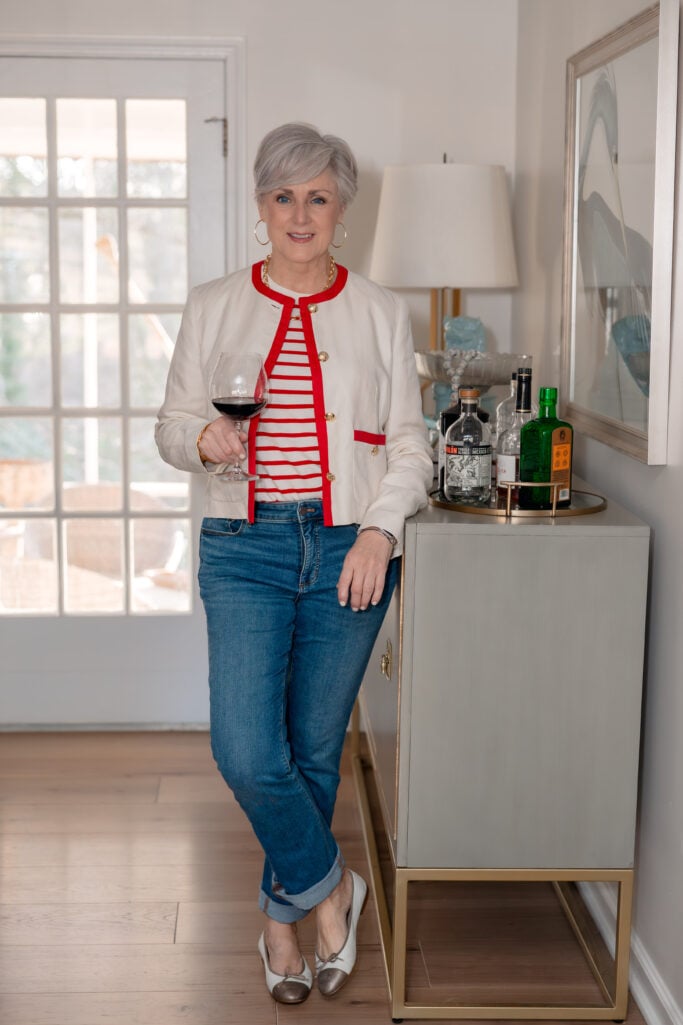
The Confidence Factor: What You Wear to a Big Moment Matters
I want to be honest about something: I was nervous walking into that pitch. I did not want to go. I never want to go — not to the things that matter most, anyway. There is always a moment, sometimes in a hotel room but typically in my closet, usually while I’m getting dressed, where every reasonable part of my brain suggests I could simply not do this.
I always go anyway. I gather myself up, I put on the jacket, and I walk through the door. Every single time.
Over the past two weeks, I attended back-to-back writers’ conferences — first Charlotte, then Atlanta — pitching Hidden in the Frame in person for the first time. Two cities, two conference rooms, the same ten minutes of everything I’d worked toward distilled into a conversation across a small table. No safety net. No script. Just the story and whoever was sitting across from me.
Hidden in the Frame has been years in the making. But here’s what I know after a lifetime of doing the things I didn’t want to do: the outfit helps. Not because it changes the outcome. Because it changes how you walk toward it.
One small note for readers who just finished Chapter One — you won’t find Reggie’s outfit described there. She’s simply present, simply herself, in that hospital room. Her clothes reveal themselves later in the book, the way she reveals herself: gradually, and always on her own terms.
Maybe the jacket really is lucky. Maybe I just needed to feel like myself. One thing is for certain — I’m not ruling anything out.
But no matter the outcome, this jacket now has a memory tied to it. As so many of my clothes do.
I still remember what I wore when I first met Mr. Style. It was winter, and I had on a red coat.
FAQ: Styling a Lady Jacket Over 50
What do you wear under a lady jacket?
A fitted striped tee is one of the most flattering and foolproof options. It keeps the focus on the jacket while adding a relaxed layer of texture. A simple silk shell or a fitted turtleneck work beautifully as well.
Can you wear a lady jacket with jeans?
Absolutely — and it’s one of the best pairings over 50. The contrast between the jacket’s structure and the casual ease of a straight-leg jean is exactly the kind of high-low balance that reads as effortlessly chic.
Is Ralph Lauren worth the investment over 50?
For classic, heritage pieces — especially structured jackets — yes. Ralph Lauren constructs for longevity. The Twill Lady Jacket is the kind of piece you wear for a decade, not a season.
How do you accessorize a cream and red jacket?
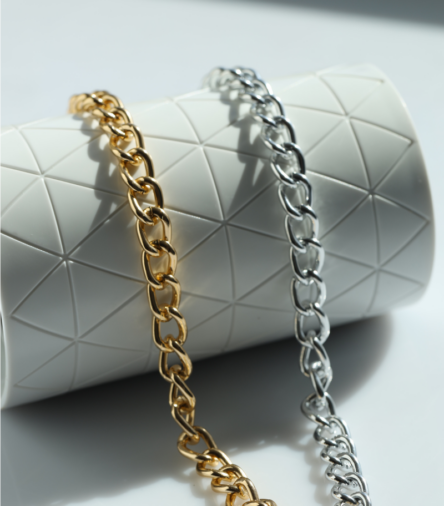
Stay within the palette or go metallic. Gold accessories echo the jacket’s hardware. Silver adds a modern, unexpected twist. Avoid competing patterns — let the jacket do the talking.
Shop the Look
/
Want to Follow Reggie’s Journey?
Hidden in the Frame is currently in agent submission, which is one of the most exhilarating and terrifying places a manuscript can be. I’ve received full manuscript requests from several agents, and I’m navigating this process with equal parts excitement and realism.
If you want to follow along — the pitches, the waiting, the news when it comes — join the Grit & Glam Club. I’ll be sharing updates there first, along with exclusive content you won’t find anywhere else.
Because the story doesn’t end with Chapter One. And neither does ours.
→ Join the Grit & Glam Club. It’s easy and absolutely free. I will share my Hidden in the Frame journey on the weekly newsletter + beauty and fashion picks, book and movie recommendations, and more!



LEAVE A COMMENT